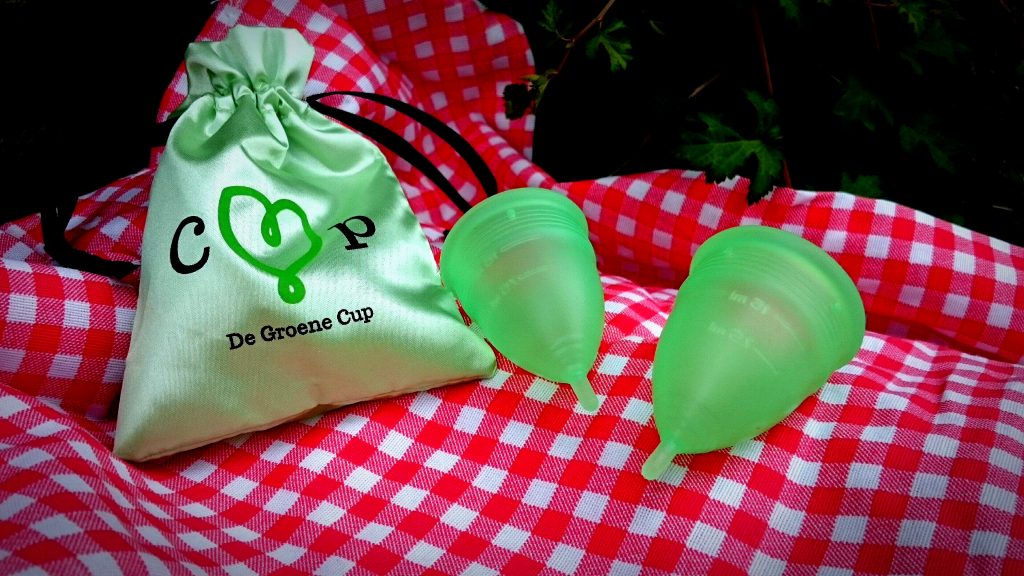
 De Groene Cup, “The Green Cup” in English, is a reusable menstrual cup. De Groene cup is a small cup made of medical-grade silicone that is inserted into the vagina much like a tampon, but lower, and sits at the base of the cervix collecting menstrual fluid. One cup can serve a woman for multiple years.
We introduced De Groene Cup in The Netherlands and Belgium in 2016. Nowadays we do also sell it to women in Germany, France, UK and many other countries. The manual of De Groene cup is available in Dutch, German in English. The more we sell the more questions we got. Many people, like customers and journalists, already ask us questions like: Is it really more sustainable? What about the cleaning? Etc. Some of them also refer to the coffee mug dilemma [1], which claims that the environmental impact of a reusable drinking cups (ceramic, glass and reusable plastic) and two types of disposable cups (paper and polystyrene foam) is nearly the same because of you will have to wash it out every time you used it.
Well, let’s calculate it! Tampons of 100% cotton are more sustainable than regular tampons from major corporations such like Johnson & Johnson and Procter & Gamble, which contain not only cotton but also plastics and other materials. [2] So, we will compare the environmental impact of 100% cotton tampons versus De Groene Cup a menstrual cup made of 100% silicone. To make a comparison which makes sense we’ll calculate the energy the produce and use these products. I’ll use the Mega-Joule (MJ) unit for the energy required to make comparing more easy.
First the 100% cotton tampons. It requires 55MJ to produce 1kg cotton. [3] When a single tampons weights 5gram and a average women uses 20 tampons for a complete menstruation (full cycle). The preceding means that a menstruation cycle costs 5.5MJ when using tampons made of 100% cotton.
Now De Groene Cup. De Groene cup is made of 100% siliconen. The energy required to produce 1kg siliconen is 235MJ. [4] A menstrual cup of siliconen weights about 15 grams. So, you’ll need 3.5MJ to produce a single menstrual cup made of siliconen. When you use such a menstrual cup a full menstruation cycle, you’ll have to clean it with (hot) water 10 times. Each time you clean your menstrualcup with drinking water you’ll spent about 230kJ. [5] So a full menstruation cycle requires 2.3KJ to clean.
Most women sterilize their De Groene Cup at the end of their period. You can sterilize your menstrual cup in the microwave. Boiling your menstrual cup for 3 minutes on 900Watt requires 0.162MJ.
As you can see it will be require a little more energy to produce one menstrual cup made of siliconen than to produce 20 tampons made of 100% cotton. But… you’ll have to produce 20 new tampons evergy cycle again whilst a menstrual cup can be used for years. Cleaning the cup requires only about 2.5MJ, so this can not offset beyond using new tampons every cycle.
When using De Groene Cup for more than even one cycle, you’ll start reducing your ecological footprint already!!
Notice that the above calculating is only a simplification, also converting the raw materials, transport, packaging, etc. requires energy. Also these costs will repeat each period when using disponsable tampons or pads. Tampons of most brand are separately sealed in platics too.
At the end of the life span of your De Groen Cup you can not easily recycle your Cup, but some suggestions can be found. [6] Also realize that many sanitary napkins, tampons and applicators are dumped wrapped in plastic bags which can take centuries to biodegrade. [7].
Try it yourself
Women from the Netherlands and Belgium can order a De Groene Cup at webvrouw.nl and cutecotton.nl. Women from other countries can order at menstrualcups.eu. De Groene Cup is also available at bol.com and Amazon.
End notes:
[1,7] Reusable vs. Disposable Cups – Tufts Office of Sustainability | Institute for Lifecycle Energy Analyse | University of Victoria, 1994 | [ONLINE] Available at: http://sustainability.tufts.edu/wp-content/uploads/Comparativelifecyclecosts.pdf
[2] The Ecological Impact of Feminine Hygiene Products | Shreya | Havard Business School, 2016 | [ONLINE] Available at: https://rctom.hbs.org/submission/the-ecological-impact-of-feminine-hygiene-products/
[3] Estimating the carbon footprint of a fabric | O Ecotextiles, 2011 | [ONLINE] Available at: https://oecotextiles.wordpress.com/2011/01/19/estimating-the-carbon-footprint-of-a-fabric/
[4] How much energy does it take (on average) to produce 1 kilogram of the following materials? | LOW-TECH MAGAZINE, 2014 | [ONLINE] Available at: http://www.lowtechmagazine.com/what-is-the-embodied-energy-of-materials.html
[5] Energy Requirements of Disposable Cups vs. Reusable, and Required # of Reuses to Break-even | Jason Munster’s Energy and Environment Blog, 2012 | [ONLINE] Available at: http://www.jasonmunster.com/disposable_cups-1/
[6] How To Recycle A Menstrual Cup | Rubycup.com | Lara Elena Thiele, 2016 | [ONLINE] Available at: http://rubycup.com/blog/how-to-recycle-a-menstrual-cup/
 Responsive design is hot, so responsive advertising is hot too. That’s why we see many new ads techniques and strategies. You will find a nice example of technique on